

Trust Technology Consultants - All Things Technology
How to Spot Cybersecurity Risks Before They Turn Into Costly Outages

The warning signs of a cyber incident usually show up months before the outage. Most organizations just don’t recognize them for what they are.
This is where a cybersecurity risk assessment earns its keep. Not as a compliance exercise, but as a practical way to identify vulnerabilities, understand impact, and reduce the likelihood that a small technical issue becomes a costly outage.
Why read this?
If your business depends on uptime, data access, and connected systems, this article will help you understand how small, overlooked cybersecurity risks quietly turn into operational disruptions, revenue loss, and executive-level headaches. You’ll learn what to watch for early, why these issues compound, and how a structured cybersecurity risk assessment can surface problems before they escalate.
A Quiet Reality Most Businesses Face
Many mid-sized organizations believe they are “reasonably secure” because nothing bad has happened yet. In reality, they are often operating with limited cybersecurity visibility, outdated infrastructure, and informal security decisions made under time pressure.
A proper IT security risk assessment doesn’t just look for threats. It connects technical weaknesses to business consequences like downtime, lost productivity, regulatory exposure, and reputational damage.
If your organization has never formally mapped those connections, you are likely carrying more risk than you realize.
Psst. This is often the point where companies realize they don’t need more tools. They need clarity around where risk actually lives and what matters most. Start with a free quote to understand your exposure without obligation.
The Early Warning Signs Offices Tend To Miss
Cybersecurity risks for businesses usually blend into the day-to-day and are easy to rationalize.
- Unpatched software risks get deferred because updates might disrupt operations.
- Weak access controls evolve organically instead of intentionally.
- Security misconfigurations remain after vendor installs or rushed projects.
- Unsecured business networks support remote and hybrid work.
- Endpoint security gaps appear across laptops, mobile devices, and unmanaged assets.
- Third-party vendor security risks persist long after access should have been reviewed.
- Cloud security risks emerge from default settings and unclear ownership.
Individually, these feel minor. Collectively, they create the conditions for ransomware attacks on businesses, phishing attacks in the workplace, and insider security threats that bypass traditional defenses.
How Small Issues Escalate Into Downtime
The operational impact of cyber incidents rarely stays contained within IT. Phishing attacks in the workplace become far more effective when paired with weak access controls. Unpatched software risks turn critical when combined with exposed remote access. A single compromised endpoint can cascade across the network when segmentation and monitoring are insufficient.
Mapping Risk To Real-World Impact
A strong network security risk assessment ties technical findings directly to business outcomes.
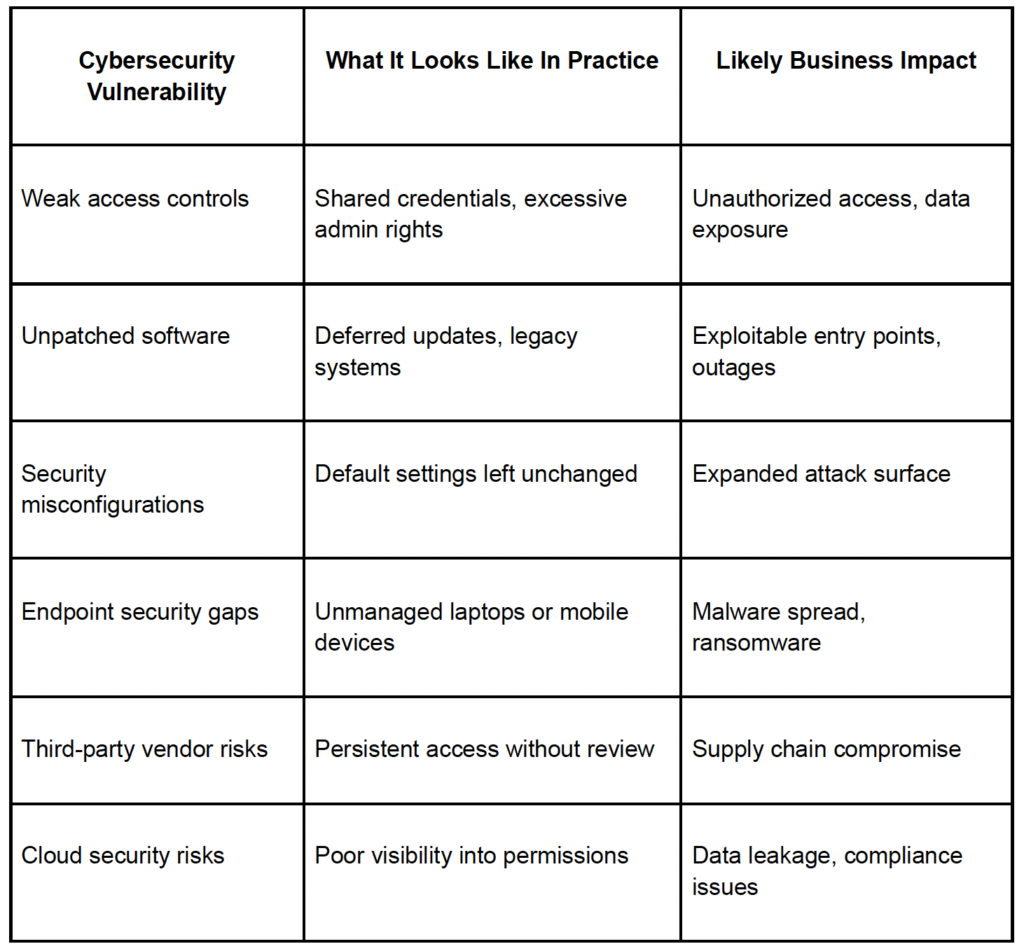
P.S. Trust Technology Consultants specializes in translating findings like these into executive-level clarity. Their assessments focus on operational impact, not fear-based reporting, and organizations can request a free quote to see where risk intersects with real business exposure.
Why Cybersecurity Risk Assessment Is a Business Function, Not An IT Task
Executives often ask why companies conduct cybersecurity risk assessments if they already have security tools in place. The answer is simple: assessments help prioritize risk.
Cyber risk management requires understanding which systems support revenue, which outages would halt operations, and which incidents would trigger regulatory or contractual consequences. This is where cybersecurity, business continuity planning, and leadership decision-making intersect.
When cybersecurity is treated purely as a technical function, risk decisions happen in isolation. When it’s treated as a business discipline, leaders gain control over trade-offs, timing, and investment.
The Cost Of Waiting Until Something Breaks
Cybersecurity vulnerabilities don’t become dangerous overnight. They become dangerous when they remain invisible, unprioritized, and unresolved.
A cybersecurity risk assessment brings those risks into focus before they turn into outages, data loss, or costly operational disruptions. For businesses that depend on uptime, continuity, and trust, that visibility is no longer optional.
The real risk isn’t discovering problems. It’s discovering them too late.
Trust Technology Consultants helps organizations move from reactive firefighting to confident, informed decision-making.
You can begin with a free quote to understand your true cybersecurity risk profile.
FAQs
What is a cybersecurity risk assessment?
A cybersecurity risk assessment is a structured process that identifies cybersecurity threats, vulnerabilities, and their potential impact on business operations. It evaluates both likelihood and severity to prioritize action.
Why do companies conduct cybersecurity risk assessments?
Companies conduct cybersecurity risk assessments to reduce the likelihood of outages, business data breaches, and operational disruption by proactively identifying and addressing weaknesses.
Why is cybersecurity risk assessment important?
It connects technical security gaps to business consequences such as downtime, revenue loss, and compliance exposure, enabling smarter decision-making at the executive level.
What are the three types of risk in cybersecurity?
The three commonly referenced categories are strategic risk, operational risk, and technical risk. Together, they describe how cyber threats affect long-term goals, daily operations, and underlying systems.